Wednesday, January 29, 2014

Queensland photography cutting a cool edge this summer

http://visual.artshub.com.au/news-article/news/visual-arts/gina-fairley/queensland-photography-cutting-a-cool-edge-this-summer-197941

Ricchochet 4 by Christophe Canto. Courtesy QCP
French-Australian Christophe Canato has lived and worked in Perth since 2005. However it is his life prior that is the inspiration for these photographs. Years of working in the Paris Fashion industry as a freelance photographer, he turns that social, cultural and material affiliation into an examination of our perceptions and auto-educational interpretation of objects and memories – what he describes as synaesthesia associations. These images stimulate our cognitive and sensorial responses, such as desire and salivation.

RICOCHET © christophe canato

Saturday, January 25, 2014

RICOCHET - QCP (Queensland Centre for Photography) - January and February 2014

Christophe Canato Ricochet 2013,
metallic paper, archival pigment print
Canato’s series Ricochet alludes to stage play of a Shakespearean vein. As single images they are beautiful, enigmatic studio portraits and still lives, but seen together they are reminiscent of an elaborate storyboard for an unseen greater tale. His ambiguous and luscious photographs, lit in the manner of many renaissance paintings, delve into the psyche of childhood, a time when playing is the most important activity and everything is believable; a time when darkness hides all sorts of threats and time itself seems endless.
Ricochet is one of several French words that retains its spelling and meaning in English, and conjures gunshots ricocheting off all sorts of items in westerns, to make the improbable seem easy. Similarly it is a term that pops up in sporting commentary when a lucky deflection or bounce leads to points. In French, Canato’s first language, it is also used to describe a rock skimming across water, a favourite game of children (and quite a few adults too). In this last incarnation of the word, it takes on an even more magical sense as a rock should surely sink into the water, not dance across its surface. Like the dreams and fears of childhood, the rock defies logic for a short while, before the reality of gravity brings the game to an end.

French-Australian Christophe Canato lives and works in Perth, Western Australia since 2005. After receiving his DNSEP in 1989 (comparable to a Master degree in Fine Arts) and in 1993 a Diploma of Fashion from the prestigious Institut Français de la Mode (French Fashion Institute), Canato has drawn on his background in the Paris Fashion industry.

Thursday, October 31, 2013

Momentum Exhibition - PCP 21 years

Logo © Perth Centre for Photography

 
October 31, 2013 to December 22, 2013
 
Perth Centre for Photography http://www.pcp.org.au
Curated by Paola Anselmi
2013 is a milestone year for the Perth Centre for Photography. PCP is coming of age. It’s been an extraordinary journey of growth. From humble beginnings as the Photography Gallery of WA at the Bridge Gallery in William Street, to a second incarnation as the Photography Centre at ArtsHouse, and finally the Perth Centre for Photography on Brisbane Street and now in its new premises on Aberdeen street, the PCP’s future has never looked more positive. In over two decades of existence the PCP has made it its missions to foster, support and promote the best of photographic practice and practitioners in this state and beyond. 

Momentum is a coming of age story. It's about looking back as well as ahead to new initiatives and growth.  

Saturday, June 8, 2013

Dc Thea Costantino wrote about AD VITAM ÆTERNAM

Life, eternal

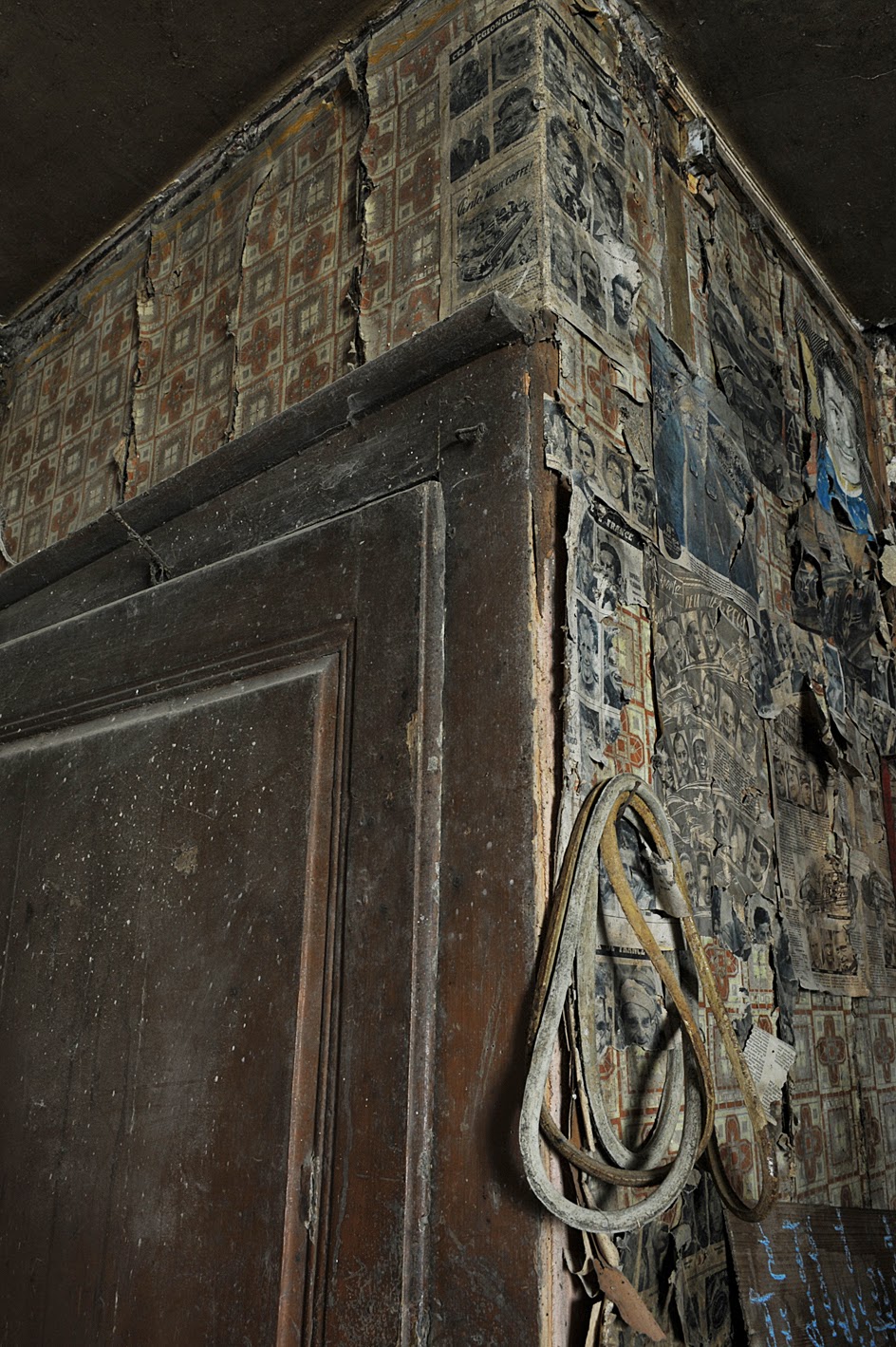
Christophe Canato’s series Ad Vitam Aeternam (To the eternal life) records a time capsule: a small village in the north of France that appears to have been struck by a fairy tale curse that has sent the entire population to sleep. Perhaps sleep isn’t quite the right word—it suggests something at rest soon to awaken, dreaming, kicking, active on a mechanical level. The state of Canato’s village is more akin to suspended animation. The rust doesn’t spread, the buildings’decay is arrested, the abundant weeds grow no worse. Blowflies have ceased to buzz in windowsills. Layers of peeling wallpaper hang precariously, fluttering flipbooks of bygone styles. Decades of pickled vegetables remain in cellars, already embalmed.  Even the dust motes are immobile, forming solid walls mid-air. The village has run out of time,
literally, and Canato reveals it as a new Pompeii.
At the centre of the village is an ancient building: a church which has survived five hundred years of natural and human disasters. At different points in its history it has been contained within the borders of this nation or that region, threatened by men with footfalls governed by drumbeats, threatened by men on horseback, men in tanks. The village is much more ancient, resting on thousand years of stratified human waste. Every time the village has been levelled, its people have simply rebuilt. Yet, improbably, the church has remained standing, oblivious of the insect lives of the creatures that have worshipped within its walls.

I imagine the village gradually changing pace, slowing down. The old people start dying, leaving mouldy attics full of dead doves, arcane farming equipment, a bride’s trousseau kept aside for a daughter who never came home. The young people leave for city jobs and only visit for funerals. The church bells ring irregularly, barely noticed—the villagers no longer rely on the schedule of prayer to tell the time of day.


Coming from a much more frenetically paced world, Canato stumbles upon the slumbering village like a lost traveller. An unnerving quiet pervades the site. It seems like an unknown atrocity has emptied the place, some nuclear disaster like Chernobyl or Fukushima, but nothing so catastrophic has caused people to abandon these buildings. The anachronistic contents of the houses, neatly packed away, show the village simply as a casualty of the slow demise of a centuries-old way of life, still visible as ruins, and at its centre an ancient church. This place waits, undisturbed, as if for the fabled kiss that can bring life back to cold, dead lips.


Thea Costantino, Curtin University, 2013